Why Your House Still Smells Like Smoke And What It Actually Takes to Fix It
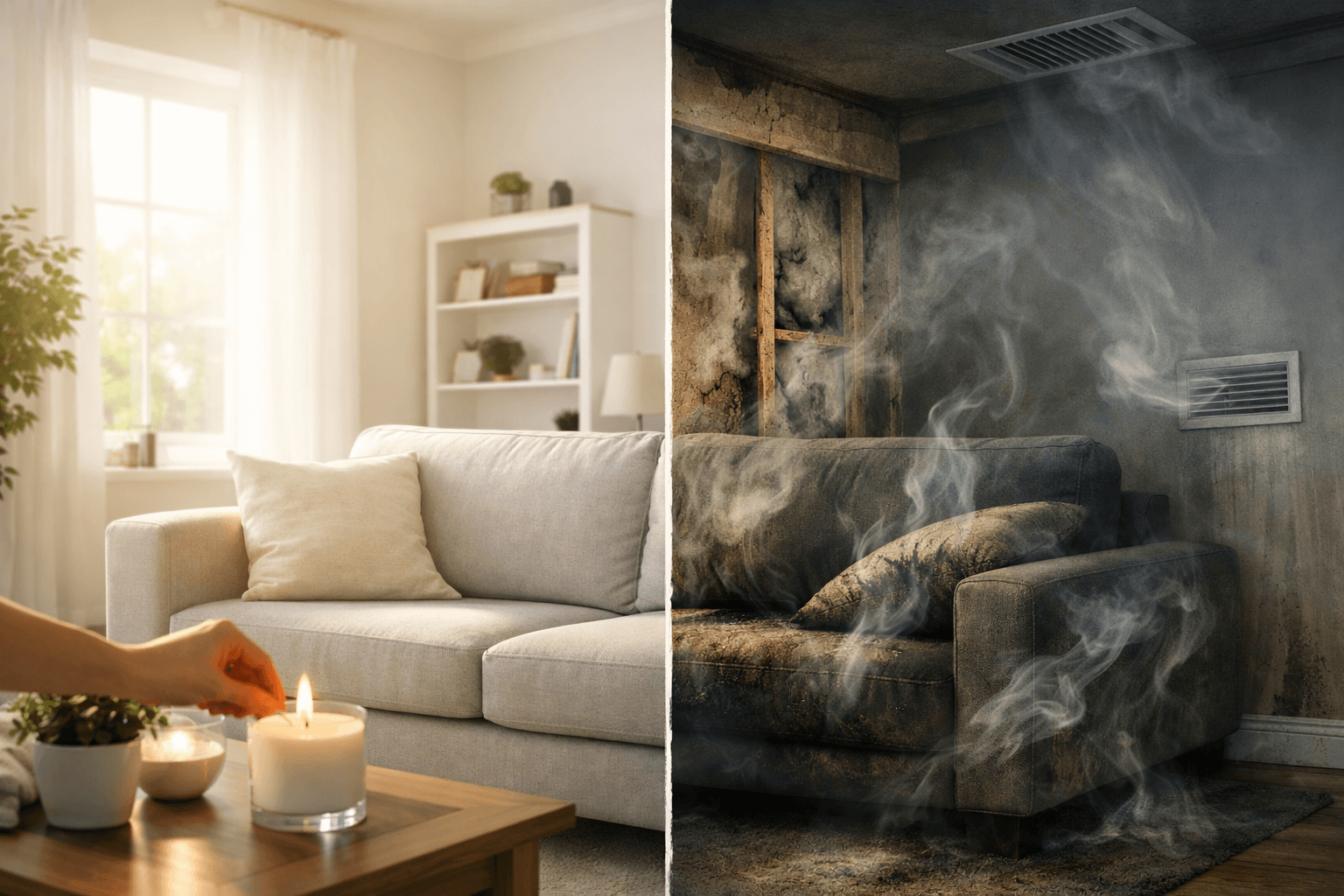
You put out the fire. You opened every window. You ran fans for days, lit candles, sprayed Febreze, and washed everything you could reach.
But the smoke smell still came back.
If this sounds familiar, you're not doing anything wrong. You're up against a chemistry problem that household cleaning products aren't designed to solve. Understanding why smoke odor persists is the first step toward actually getting rid of it. Here's what's happening inside your home, why it keeps coming back, and what professional smoke damage restoration actually involves.
Why Smoke Smell Doesn't Just Go Away
Most odors dissipate on their own. Smoke doesn't, and the reason is chemistry.
When a fire burns, it produces volatile organic compounds (VOCs): microscopic chemical particles that travel in smoke and embed themselves in virtually every porous surface they contact. Drywall, insulation, carpet, upholstery, clothing, ceiling tile, the wood framing inside your walls — they all absorb VOCs during a fire event, and then slowly release them back into the air for weeks, months, or longer.
This process is called off-gassing, and it's temperature-dependent. Researchers at the University of Colorado Boulder's CIRES institute studied this directly after the 2021 Marshall Fire, instrumenting a home next to a block of burned structures. Their findings, published in ACS Environmental Science & Technology Air, were striking: VOC concentrations inside the home resembled outdoor air pollution levels in Los Angeles in the 1990s, and the chemicals lingered for weeks. "Based on prior research, we had expected these VOCs to disappear from the home within hours, but it took weeks," said lead researcher Joost de Gouw. The study described the home as acting like a sponge, absorbing VOCs during the fire and slowly returning them to the air afterward, especially as indoor temperatures rose.
Georgia's warm climate makes this cycle more persistent than in cooler states. A room that seems fine after a cool night can smell strongly of smoke the following afternoon when the sun heats the house back up.
At the same time, soot is chemically acidic. It continues reacting with the materials it has settled on long after the fire is extinguished, etching into surfaces, discoloring walls, and releasing its own persistent odor compounds. The longer it sits untreated, the deeper and harder it becomes to remove.
The smoke smell isn't lingering in the air. It's embedded in your home's materials. Air fresheners and ventilation move air around — they don't touch the source.
Why DIY Attempts Usually Make Things Worse
The instinct to clean is the right one. The tools most homeowners reach for are the wrong ones.
Dry soot, the powdery residue left by fast-burning wood or paper fires, looks like it should wipe off easily. It does come off surfaces, but improper wiping or vacuuming with a standard household vacuum pushes particles deeper into porous materials or scatters them into the air, spreading contamination further. HEPA-grade equipment is required to capture particles at the size soot travels.
Wet soot from slow-burning or synthetic fires (plastics, foam, synthetic fabrics) is oily and smears on contact, bonding permanently to surfaces if treated with water-based cleaners. These residues require alkaline chemical solutions specifically formulated to break down the oily compounds.
Then there's your HVAC system. Once smoke enters the ductwork, your heating and cooling system becomes a distribution network, circulating soot-laden air to every room in the house every time it runs. The ANSI/IICRC S700 Standard for Professional Fire and Smoke Damage Restoration, published in 2025 as the industry's first national standard of its kind, specifically identifies HVAC inspection and decontamination as a required step in any fire restoration project. Homeowners who keep running their systems after a fire often spread contamination to rooms that were never affected by the original event. If you want to understand the full sequence of what happens after a fire — from emergency board-up through HVAC cleaning and final reconstruction — our complete smoke damage remediation timeline walks through every phase.
The Hidden Damage You Can't See or Smell Yet
The smoke smell is the signal, but it's not the only concern.
Soot's acidity causes progressive damage to the materials it contacts. On metals like fixtures, appliances, fasteners, and wiring, this means corrosion that begins within hours and worsens over days. On wood framing, it weakens fibers over time. On electronics, it can bridge circuit connections and cause failure weeks after the fire, in devices that appeared to survive undamaged.
Smoke also migrates through gaps and cavities. In most residential construction, smoke from a contained fire can travel through wall cavities, attic spaces, and around electrical penetrations, depositing soot and VOCs in areas that have no visible fire or smoke damage. A kitchen fire can leave smoke residue inside bedroom walls on the other side of the house. And as the CIRES research showed, even neighbors in adjacent homes reported headaches, sore throats, and other symptoms months after the Marshall Fire, simply from smoke that had drifted through their structures.
There's a secondary risk that's easy to overlook: firefighting water. Significant water is used to extinguish most structural fires, and that water saturates walls, floors, and framing while the focus is still on the fire itself. Because mold can begin growing within 24 to 48 hours in wet conditions, a home that has experienced a fire is at dual risk — smoke contamination and mold — if the water isn't professionally dried and treated at the same time as the smoke cleanup.
This is why professional smoke damage restoration begins with a full assessment that goes beyond visual inspection, using thermal imaging and air quality testing to map where contamination has actually traveled.
What Professional Smoke Damage Restoration Involves That DIY Doesn't
The techniques required to neutralize smoke odor at the source are industrial, not consumer-grade. Here's what makes the difference:
Ozone treatment generates ozone (O₃) molecules that react chemically with VOC odor compounds, permanently neutralizing them rather than masking them. This is done in a sealed, vacated space, as ozone at remediation concentrations is not safe to breathe, but it reaches inside walls, furniture, and every porous surface in the treated area. A scented candle doesn't.
Thermal fogging disperses a heated deodorizing compound as a fine mist that penetrates the same surfaces the smoke penetrated, neutralizing odor molecules at their source rather than on the surface.
Hydroxyl generation produces hydroxyl radicals that break down odor compounds at the molecular level. Unlike ozone, hydroxyl generators can operate while occupants are present, making them useful for ongoing treatment during the restoration process.
Chemical sponge and alkaline cleaning uses dry chemical sponges for dry soot and pH-balanced alkaline solutions for oily or wet soot, lifting residue from surfaces without driving it deeper or spreading contamination.
None of these are available at a hardware store. And none of them work correctly unless the right type is matched to the right soot, which requires knowing what burned.
The Soot Type Problem: Why One Treatment Doesn't Fit All Fires
Different materials produce fundamentally different soot when they burn, and each requires a different treatment approach. Applying the wrong method doesn't just fail to clean — it can make surfaces harder or impossible to restore.
Wood and paper fires produce dry, powdery soot that responds to HEPA vacuuming and dry chemical sponges. Water-based cleaning smears it and drives it into porous surfaces.
Plastic and synthetic fires produce thick, oily wet soot that requires alkaline wet cleaning. Dry sponging won't touch it.
Protein fires, typically kitchen grease fires, produce a nearly invisible residue with an extremely powerful, persistent odor. They require enzyme-based treatments and aggressive deodorization, and are frequently underestimated because the damage isn't visually obvious.
Mixed material fires require sequenced treatment combining multiple methods in the correct order.
Identifying the fire type and soot category is the first thing a trained restoration technician does — it's the decision that determines every cleaning method applied afterward.
When to Call a Professional vs. Handle It Yourself
Not every smoke incident requires full professional restoration. Here's a practical framework:
DIY is reasonable when:
- Smoke exposure was brief and limited to one small area
- No porous materials (drywall, insulation, carpet, upholstery) were heavily exposed
- There's no detectable odor after 48 to 72 hours of ventilation
- The affected surface area is small enough to wipe down with appropriate chemical sponges
Professional restoration is needed when:
- Odor persists after 48 to 72 hours of ventilation and basic cleaning
- Soot is visible on walls, ceilings, or surfaces beyond the immediate fire area
- The fire involved plastics, synthetics, or building materials rather than just paper or wood
- Your HVAC was running during or after the fire event
- Any area of the home shows discoloration, staining, or film on surfaces
One more factor often missed: if firefighters used water to extinguish the fire, you're dealing with two separate damage events at once. Understanding the category of water involved matters because water from firefighting is typically classified as Category 2 or 3, meaning it carries contaminants and requires a more aggressive drying and sanitation protocol than a standard pipe burst.
Georgia's humid climate adds another consideration. Humidity accelerates VOC off-gassing and reactivates smoke odor compounds in materials that seemed clean after cooler, drier periods. A house that smells fine in January may smell strongly of smoke in April when the weather shifts. If the odor is returning seasonally, the source is still in the materials and hasn't been fully treated.
What Happens If You Leave It
Smoke damage is not a static problem. Left untreated, it actively worsens:
- Soot's acid continues etching and corroding surfaces and materials
- VOCs continue off-gassing at lower concentrations indefinitely, reducing indoor air quality
- Smoke-damaged materials weaken structurally over time
- Discoloration deepens and becomes permanent on some surfaces
- Property value decreases, as disclosure requirements and inspection findings related to past fire damage can complicate a sale
The restoration window also narrows. The CIRES researchers noted that VOC concentrations declined rapidly at first and then much more slowly, meaning early intervention captures the steepest part of the curve. Soot that has been bonding to surfaces for weeks is measurably harder and more expensive to remove than soot treated within the first 24 to 72 hours.
Before any cleanup begins, it's also worth understanding whether your homeowners policy covers fire and smoke damage — and how the documentation your restoration company provides affects your claim. Policies typically cover sudden and accidental fire damage, but the adjuster will expect detailed moisture readings, soot mapping, and a line-item scope of work to process the claim correctly.
Serenity Restoration: Smoke Damage Cleanup in the Atlanta Metro Area
At Serenity Restoration, we provide fire and smoke damage cleanup for homes and businesses across Tucker, Atlanta, Duluth, Lawrenceville, Decatur, and surrounding communities. Our approach starts with a proper assessment, identifying soot type, mapping contamination, and testing air quality, before selecting the appropriate treatment combination for your specific situation.