



Attic Mold Removal in Georgia: Causes, Cost & How to Fix It

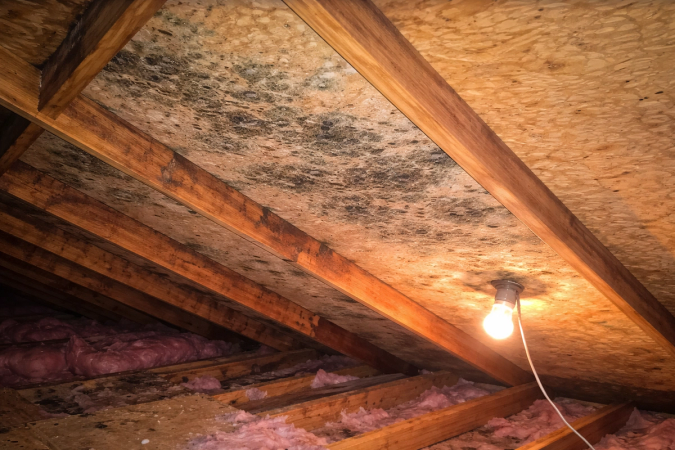
Most Georgia homeowners discover attic mold one of three ways: during a home sale inspection, after an HVAC contractor goes up for a routine check, or when a musty smell on the upper floor finally becomes impossible to ignore.
By that point, the mold has usually been growing for months.
Attics are Georgia's most overlooked mold risk — and one of the most common calls we receive at Serenity Restoration. This guide covers why attic mold is so prevalent here, what professional remediation actually involves, what it costs, and what your insurance likely covers.
Why Attics Are Georgia's Most Common Mold Hotspot
Mold needs three things: moisture, organic material to feed on, and warmth. A Georgia attic during summer provides all three in abundance.
The humidity problem
Georgia's average summer relative humidity regularly exceeds 70 percent. That moisture-laden outdoor air infiltrates attics constantly — through soffit vents, ridge vents, gaps around penetrations, and any unsealed openings. When that warm humid air contacts the cooler underside of roof decking (cooled by air conditioning running below), it condenses. The result is the persistent, low-level moisture that mold needs to colonize wood framing and sheathing.
The EPA's guidance on mold and moisture notes that controlling indoor moisture is the most critical factor in mold prevention — and Georgia's climate makes that particularly challenging without proper attic ventilation design.
The ventilation problem
Most attic mold problems in Georgia come down to inadequate or imbalanced ventilation. The standard intake/exhaust ventilation system — soffit vents at the eaves pulling in cooler outside air, ridge or gable vents at the peak exhausting hot air — works well in theory. In practice, many Georgia homes have:
- Soffit vents blocked by insulation
- Gable vents that short-circuit the airflow before it reaches the ridge
- Bathroom or kitchen exhaust fans that vent directly into the attic rather than through to the exterior
- HVAC ductwork leaking conditioned air into the attic space
Any of these creates the moisture imbalance that feeds mold.
The organic material problem
Roof decking is typically oriented strand board (OSB) or plywood — both of which are ideal mold substrates. Attic framing is dimensional lumber. Insulation may be paper-faced. All of it is available for mold to colonize once moisture levels are sufficient.
The Most Common Causes of Attic Mold — and the One People Miss
The obvious causes are roof leaks and ice dams. In Georgia, ice dams are rare, but roof leaks — from aging shingles, failed flashing, or storm damage — are common causes.
The cause people most often miss: exhaust fans venting into the attic.
A bathroom exhaust fan that terminates in the attic rather than outside vents warm, moist air directly into the one space where mold conditions already exist. Over time, this creates persistent moisture accumulation that can cover large sections of decking. We see this in a significant percentage of the attic mold jobs we respond to across Atlanta, and homeowners are almost always surprised to learn it.
Other frequently missed causes:
- Inadequate ridge ventilation after a re-roof job where baffles were not properly maintained
- Whole-house humidifiers that add moisture to the HVAC system, some of which ends up in attic spaces
- Air sealing failures between conditioned living space and the attic that allow humid interior air to infiltrate
Warning Signs You Have Attic Mold Even If You Can't See It
You may not go into your attic often. Here are the signs that warrant a professional inspection:
- Persistent musty odor on the top floor of your home , particularly in rooms directly below the attic
- Dark staining on the underside of roof decking visible if you do go up — ranges from gray to black
- Allergy-like symptoms that improve when you leave the house, particularly in upper-floor rooms
- High utility bills that suggest the attic insulation's effectiveness has been compromised by moisture
- A recent failed home inspection that flagged "microbial growth in attic" — common wording in home sale inspections
What Professional Attic Mold Removal Actually Involves, Step by Step
Mold remediation is not a cleaning job. It is a structured process governed by IICRC S520 standards — the industry standard for professional mold remediation.
Step 1: Inspection and third-party testing
A proper remediation begins with a thorough inspection and, in most cases, air and surface sampling by a third-party industrial hygienist. The hygienist identifies the species and concentration of mold, confirms the extent of contamination, and establishes the post-remediation clearance standard — the benchmark the job must meet before the attic is cleared for re-use.
Step 2: Containment
The affected attic area is sealed off with critical barriers and placed under negative air pressure to prevent spores from migrating into living spaces during the remediation process.
Step 3: HEPA air filtration
HEPA filtration units run continuously during remediation, capturing airborne spores throughout the process.
Step 4: Removal and treatment
Porous materials with active mold growth — OSB, plywood decking, contaminated insulation — are removed. Salvageable framing is treated with EPA-registered antimicrobial solutions. HEPA vacuuming removes residual spore material from all surfaces.
Step 5: Moisture source correction
This is the step that determines whether the mold comes back. Before the attic is restored, the underlying moisture source must be identified and corrected — whether that means rerouting an exhaust fan, improving ventilation, repairing a roof leak, or addressing an insulation problem. Without this step, mold will return.
Step 6: Clearance testing
A return visit from the third-party industrial hygienist confirms that post-remediation air and surface samples meet the agreed clearance standard. Until clearance is passed, the job is not complete.
How Much Does Attic Mold Removal Cost in Georgia?
Attic mold remediation cost varies significantly based on the extent of contamination, the materials affected, and whether structural repairs are needed.
As a general range for the Atlanta metro area:
- Minor surface mold (limited area, no material removal): $1,500 – $3,500
- Moderate contamination (partial decking removal, treated framing): $3,500 – $8,000
- Extensive contamination (full decking replacement, ventilation correction): $8,000 – $20,000+
These ranges reflect labor, containment, testing, and materials. Costs increase if the remediation reveals a roof leak that requires repair, or if HVAC ductwork in the attic needs to be addressed.
Contact us for a free inspection — we will assess your specific situation and provide a transparent estimate before any work begins.
Does Homeowners Insurance Cover Attic Mold Remediation?
The answer depends on two things: the cause of the mold, and how quickly you acted.
When it is likely covered
If the mold resulted from a covered sudden event — a roof breach from a storm, a burst pipe, an appliance failure — insurance generally covers mold remediation as a secondary consequence of the original covered loss. This is particularly true when the claim is filed promptly and remediation begins quickly.
The Georgia Department of Insurance publishes consumer resources on what homeowners policies typically cover.
When it is typically not covered
- Mold that resulted from long-term humidity and inadequate ventilation (gradual damage)
- Mold that worsened because the homeowner delayed remediation after discovering it
- Mold excluded by a specific policy endorsement
Serenity Restoration has a licensed insurance adjuster on staff who can help evaluate your specific policy coverage and communicate directly with your insurance company throughout the claim process.
Why DIY Attic Mold Removal Often Makes It Worse
We understand why homeowners try to handle attic mold themselves. A can of mold-killing spray is $15. A professional remediation is thousands of dollars.
The problem is that improper mold removal — spraying a fungicide without addressing the moisture source, disturbing mold without proper containment, cleaning visible mold without testing for hidden growth — typically disperses spores more widely without eliminating the infestation. The EPA explicitly advises that mold growth covering more than 10 square feet should be handled by a professional contractor. Attic mold rarely stays under 10 square feet.
DIY attempts that fail to achieve clearance testing often result in a more expensive professional job later — and in some cases, in failed home sale transactions when a buyer's inspector discovers mold that was treated but not remediated.
Frequently Asked Questions
How do I know if I need mold testing or just removal?
Testing tells you the species, concentration, and extent of contamination — and establishes the clearance standard your remediation must meet. For insurance claims, third-party testing documentation is valuable. For any significant visible growth, testing is recommended before remediation begins. Contact us and we can advise based on your specific situation.
Can I stay in my home during attic mold remediation?
In most cases, yes. Proper containment and negative air pressure prevent spores from entering living spaces. Your technician will advise based on the specific scope of work.
How long does attic mold remediation take?
Most attic jobs take 1 to 3 days, depending on scope. Larger jobs involving full decking replacement take longer. Clearance testing adds a return visit.
Will the mold come back?
If the moisture source is corrected and clearance testing is passed, professionally remediated attic mold does not recur. Mold that returns after remediation indicates either an incomplete job or an unaddressed moisture source.
Do you handle the roof repairs and ventilation corrections too?
Yes. Through our construction and rebuild service , we can manage roof repairs, ventilation upgrades, and exhaust fan rerouting as part of the same project.
Restoring Calm, When It Counts.
If you have noticed a musty odor, discoloration in your attic, or a home inspection flagged mold, don't wait. Early intervention is significantly less expensive than remediation after mold has spread.